Reducing Repetitive Questions: 5 Effective Strategies


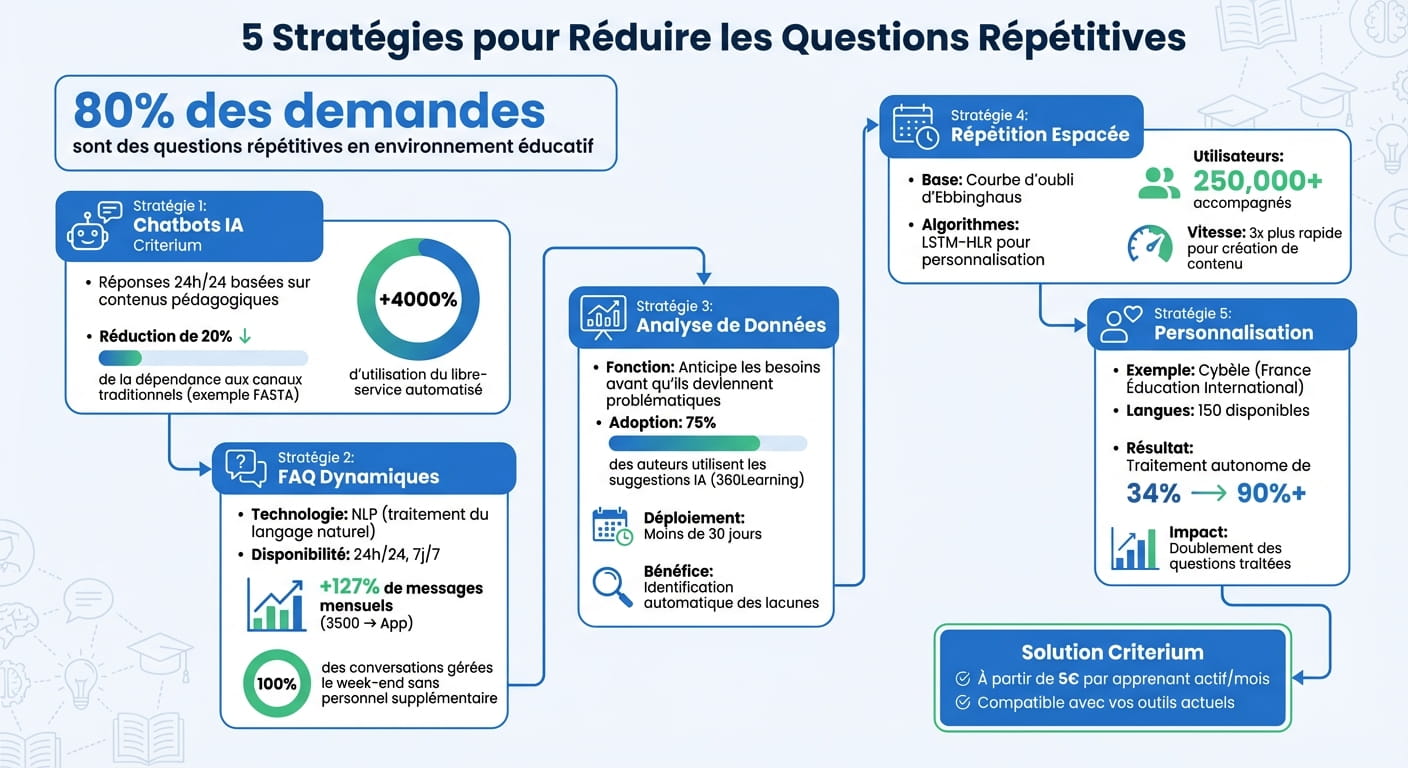
Repetitive questions like "How do I reset my password?" or "Where can I find the course materials?" account for up to 80% of inquiries in educational settings. This overloads teaching teams, increases response times, and diverts attention from complex learner needs.
To address this, here are 5 practical strategies that combine AI tools, data analytics, and pedagogical techniques:
- AI Chatbots (e.g. Criterium): Provide precise 24/7 answers based on course content.
- Dynamic FAQs: Centralize and automate answers to frequently asked questions.
- Data Analytics: Anticipate learner needs and identify knowledge gaps.
- Spaced Repetition: Strengthen memorization to reduce recurring questions.
- Personalization: Humanize tools to encourage user engagement.
These solutions reduce team workload, improve the learner experience, and ensure consistent responses. Discover how to implement them to transform your training environment.
Related Guides
1. Use an AI Chatbot Like Criterium
Effectiveness in Reducing Repetitive Questions
Criterium leverages RAG (Retrieval-Augmented Generation) technology to provide precise answers based on your course materials — slides, notes, exercises, or transcripts. This ensures that responses are directly tied to your educational content.
A notable example comes from FASTA, a South African fintech company, which integrated an AI agent into WhatsApp in October 2025. This change reduced dependency on traditional channels (phone and email) by 20% and spectacularly increased the number of clients using automated self-service for their transactions by 4,000%.
This ability to streamline responses integrates perfectly into current pedagogical systems while reducing the workload on teams.
Easy Integration with Existing LMS Platforms
Criterium is designed to work with platforms like Moodle or Canvas via a simple plugin that automatically generates an API key. For instance, EPFL (Swiss Federal Institute of Technology) introduced AI tutors integrated into Moodle in 2026. These tools, trained on course-specific documents, provide continuous 24/7 assistance while allowing teaching assistants to validate answers before sharing them with students.
This model shows how a tool like Criterium can lighten repetitive tasks and free up time for more strategic pedagogical activities.
Strengthening Learner Engagement
The chatbot provides a space where learners can ask questions without fear of judgment — something they might avoid doing in class. It can also adopt a Socratic method, offering hints and leads to encourage critical thinking.
Anonymous interaction logs are also an asset for trainers, allowing them to identify and correct areas of confusion. As EPFL explains:
Let the bot handle basic or repeated questions.
This way, teaching teams can focus on more personalized and in-depth support on complex topics. It creates a balance where technology and humans work hand in hand to improve the learning experience.
2. Build a Dynamic FAQ System
After examining the advantages of AI chatbots, let's look at another powerful tool: the dynamic FAQ system. It automates and centralizes answers while delivering an optimized user experience.
Effectiveness in Reducing Repetitive Questions
A dynamic FAQ system is ideal for managing recurring questions. Using technologies like Natural Language Processing (NLP), these systems understand the intent behind various phrasings. For example, they know that "I can't log in" often relates to password reset requests.
A concrete example: Emma, a fintech app, adopted the Crisp AI chatbot in 2026 to handle weekend demand peaks. The result? 100% of conversations handled during these periods, with a monthly message volume increase of 127% (from 3,500 to 7,200 messages), without hiring additional staff. Geoffrey Safar, Head of Operations, highlighted:
It's not about replacing support. It's about taking care of customers — even when no one is online.
Easy Integration with Existing LMS Platforms
Modern dynamic FAQs integrate easily with LMS platforms like Moodle, Blackboard, or Canvas. Through the IMS Learning Tools Interoperability (LTI) protocol, AI assistants can operate directly within these environments.
A key point: connecting these systems to a centralized knowledge base (Google Drive, Notion, or internal databases). This approach ensures consistency in information provided to all learners, avoiding discrepancies due to human interpretation.
Strengthening Learner Engagement
24/7 availability is a crucial advantage, especially when 30–40% of questions are asked outside class hours. Learners can interact in their own words, making the experience more fluid and intuitive.
Additionally, these systems feature built-in analytics that detect unsuccessful searches, helping administrators enrich the knowledge base based on real needs.
Scalability and Adaptability
Dynamic FAQ systems adapt to various needs: admissions, financial aid, technical support, or teacher assistance. By automating these tasks, teaching teams can focus more on personalized learner support.
For institutions sensitive to data privacy, locally hosted solutions are available. For example, EPFL integrated AI tutors into Moodle, ensuring all interactions remain secure within the institution's infrastructure.
Key Takeaway
Dynamic FAQs complement AI chatbots by providing structured, always-up-to-date answers. Combined with NLP, they understand intent behind varied phrasings and can handle 100% of conversations during off-hours.
3. Use Data Analytics to Anticipate Questions
After implementing chatbots and dynamic FAQs, data analytics takes things further by identifying gaps before they become problematic.
Reducing Repetitive Questions Through Data
Predictive analytics transforms data into actionable insights. By identifying "top intents" — frequent queries that lack clear answers — administrators can adjust FAQs or resolve LMS navigation issues before they escalate. This also helps fill gaps in institutional knowledge, enabling automatic redirection of Level 1 and 2 repetitive questions.
Algorithms can also spot trends in quizzes and exams. If many students consistently fail a specific question, the system alerts the instructor, who can intervene quickly to prevent this gap from generating repeated questions.
Strengthening Learner Engagement
By monitoring data such as session duration, response times, and interaction frequency, it becomes possible to predict disengagement risks. Some AI tools even analyze learner emotions through natural language processing.
A notable example: in June 2023, 360Learning integrated a ChatGPT-based question generation feature via Azure OpenAI. This innovation enabled content creators to design relevant questions in multiple languages. Result? Over 75% of authors adopted the suggestions to enrich their courses.
Simplified LMS Integration
Setting up these tools can be surprisingly simple. With Moodle, for example, it often just requires adding a script in the "Additional HTML" section of site administration. Most institutions can launch a predictive analytics system in under 30 days.
Oklahoma City Community Colleges (OCCC) are a good example. In 2025, they used Kommunicate to connect OpenAI to Moodle, providing 24/7 student support. Students could resolve exam lock issues at any hour, which proved crucial during assessment periods.
Adaptable to All Situations
These systems easily adjust to question volume fluctuations, especially during busy periods like enrollment or final exams. Using Bloom's taxonomy, questions are classified by cognitive level, from simple fact recall to complex analysis. This classification determines whether repeated questions reveal a lack of fundamental knowledge or a need for deeper understanding.
4. Apply Spaced Repetition Techniques
Spaced repetition, complementing chatbots and FAQ systems, plays a key role in learning by strengthening long-term memorization.
This method is based on Ebbinghaus's forgetting curve. By reactivating knowledge at precise intervals, it helps permanently anchor information in memory. This enables learners to better master essential concepts while reducing repetitive questions on topics already covered.
Effectiveness in Reducing Repetitive Questions
Modern tools go well beyond simple flashcards. Using algorithms like LSTM-HLR, adaptive learning systems personalize revision plans based on each user's needs. By automatically adjusting exercise difficulty, these technologies allow learners to consolidate their knowledge before progressing. Some AI platforms already support over 250,000 users in their educational journeys.
"This solution provides students with a personalized path based on their knowledge. Mastery is assessed using an exercise base and dashboards, enabling identification of struggling students." — Ekaterina Lavocat, Project Manager
Easy Integration with Existing LMS Platforms
Integrating spaced repetition into current LMS platforms is straightforward thanks to standards like SCORM, xAPI, and LTI. These modules can be added without requiring a complete system overhaul. AI platforms also automate educational content creation by generating quizzes and summaries from existing documents, speeding up the process by up to three times.
Strengthening Learner Engagement
Adaptive learning transforms how students interact with content. By adjusting paths in real-time based on performance, these systems maintain an optimal difficulty level, stimulating engagement. Error analysis also determines when to provide an alternative explanation rather than simply repeating a question.
Scalability and Adaptability
Spaced repetition systems work for all types of learners. Since the forgetting curve varies from person to person, deep learning algorithms adapt revisions to each user's individual memory. Whether training 50 or 50,000 people, these platforms scale without generating administrative overhead.
5. Personalize Tone and Brand Identity
Once technical aspects are optimized, adding a human touch to the interface can significantly strengthen the connection with learners.
Giving a chatbot a personality changes everything. Assigning it a name and distinct identity makes it much more than a simple tool. It inspires trust and encourages users to ask questions without hesitation.
Reducing Repetitive Questions
In January 2024, France Éducation International introduced "Cybèle", a chatbot with generative AI and its own personality. Created in partnership with Ideta, under the supervision of Aure Ponnelle, head of the diploma recognition department's management unit, "Cybèle" transformed a rigid interface into a smooth conversational experience available in 150 languages. The result? Autonomous request processing went from 34% to over 90%, while doubling the number of questions handled on key pages.
"Now fully personified, Cybèle has become a true intelligent point of contact, capable of providing precise, empathetic, and contextual responses, while adapting to the user's profile and language." — Ideta
A warm and respectful tone plays a crucial role. Studies show that an environment perceived as hostile can discourage students from speaking up. Conversely, using language that highlights opportunities rather than mistakes — for example, preferring "How can we strengthen this skill?" over "What did you do wrong?" — helps overcome barriers and encourages a constructive approach.
Encouraging Learner Engagement
A personalized tone helps anchor positive experiences. Even if a student forgets a specific answer, they'll remember the pleasant feeling associated with the interaction, which reduces frustration and limits repetitive questions. Additionally, by replacing generic responses like "Did you understand?" with more targeted and reflective questions, the chatbot better captures attention and promotes active learning.
Criterium lets you fully customize your chatbots' identity, from the tone used to visual elements, to perfectly align with your institution's image. This creates a welcoming and stimulating learning environment.
Conclusion
Repetitive questions in training are not inevitable. By combining tools like AI chatbots, dynamic FAQ systems, predictive data analytics, spaced repetition, and personalized tone, it's possible to profoundly transform the learner experience.
The numbers speak for themselves: these approaches significantly lighten the support team's workload while improving the user journey. The result? 24/7 accessible support, uniform and content-adapted answers, and a better understanding of gaps through interaction analysis. This information allows you to adjust your training materials proactively and effectively.
Criterium integrates these strategies into a comprehensive solution, available from €5 per active learner per month. Start by identifying recurring questions specific to your environment, then implement these tools with Criterium. Compatible with your current tools and aligned with your identity, it also provides valuable analytics to perfect your support.
Frequently Asked Questions
How can I reduce repetitive questions?
To limit recurring questions, tools like educational chatbots or smart FAQ systems can be very effective. Imagine an AI-powered chatbot, specifically trained on your course content: it could provide instant and precise answers to learners without human intervention. At the same time, enriching a knowledge base with advanced technologies anticipates user needs and automates answers to the most common questions.
How do I prevent the chatbot from giving wrong answers?
To reduce incorrect chatbot responses, consider these strategies: integrate supervised feedback techniques combined with machine learning to identify and correct errors; use RAG (Retrieval-Augmented Generation) systems that allow the chatbot to rely on a well-structured database for precise answers; and implement human supervision to monitor responses, especially when the chatbot shows signs of uncertainty.
What data should I track to anticipate learner needs?
To better understand and respond to learner needs, track key data such as learning profiles, platform behavior, and engagement levels. AI-powered tools like interactive dashboards monitor important indicators: connection frequency, session duration, and module progression. This data allows you to adjust support based on each learner's specific needs and quickly identify potential difficulties before they become major obstacles.
Ready to eliminate repetitive questions?
Criterium integrates with your LMS via LTI 1.3 in under 30 minutes. Start with a free trial and see how AI transforms your learner support.
Ready to add AI to your LMS?
Create a free account and have your AI assistant running in 5 minutes.
Get started free