AI Chatbots for Training: 7 Key Benefits


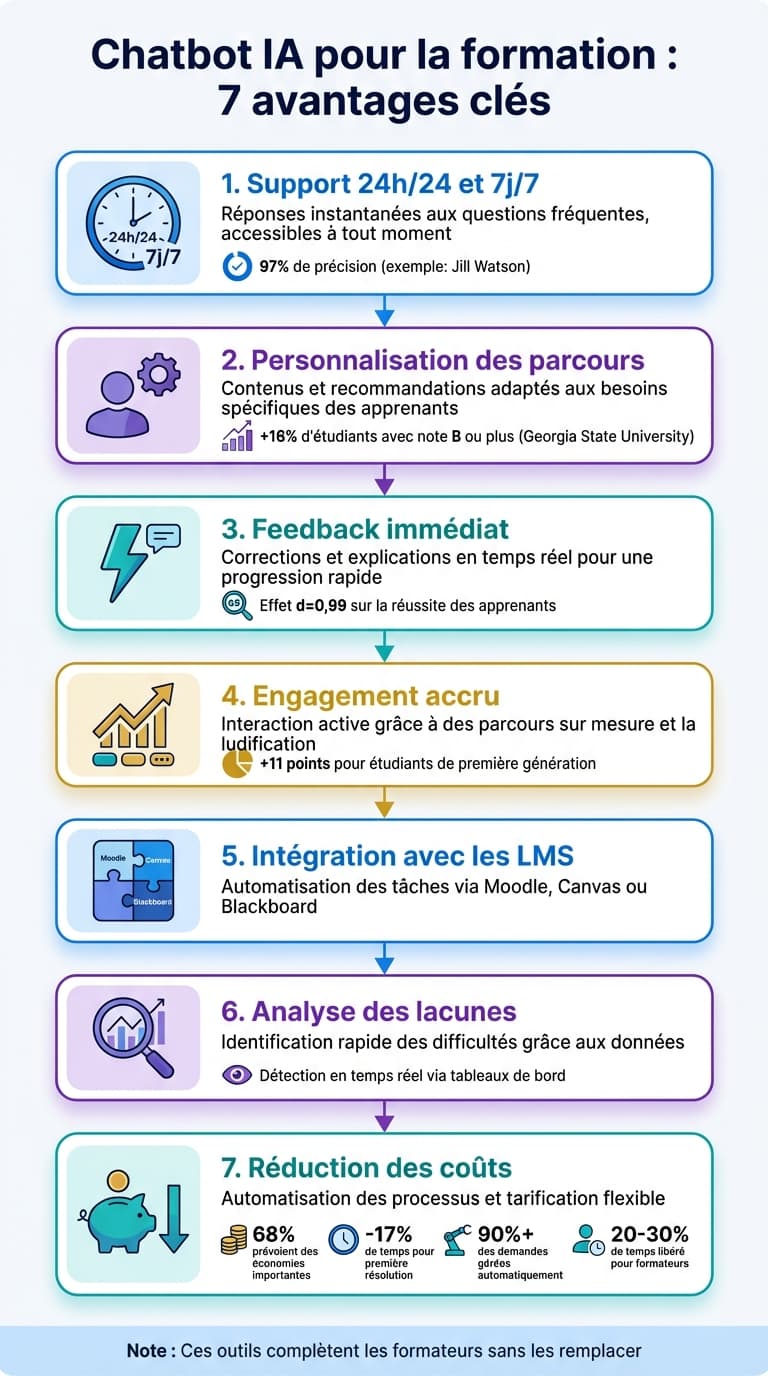
AI chatbots are revolutionizing online training by offering concrete solutions to the challenges faced by learners and educational teams. From 24/7 support and personalized learning paths to instant feedback and cost savings, here are the 7 key benefits they bring to modern training programs.
Related Guides
1. Continuous 24/7 Support
Always-On Availability
Not all learners follow the same schedule. Some prefer to study early in the morning, others late at night, or between other commitments. This is where AI-powered chatbots shine: they provide instant, continuous assistance, answering common questions like deadlines, course instructions, or resource access.
Take the example of the University of Galway, where the virtual assistant "Cara" is available 24/7. Cara helps students with various tasks, from reporting a lost student card to finding a classroom. Meanwhile, administrators use interaction data to detect trends, such as an increase in mental health support requests.
LMS Platform Integration
Chatbots are particularly effective when integrated directly into Learning Management Systems (LMS) like Moodle, Canvas, or Blackboard. At the Georgia Institute of Technology, the "Jill Watson" chatbot was introduced in 2016 for a master's-level online course. With years of data, Jill now answers 97% of repetitive questions accurately. Through its LMS connection, it automates tasks like checking calendars, verifying grades, and sending deadline reminders.
Another notable example comes from Georgia State University, where the "Pounce" chatbot was updated in 2021 to offer targeted interventions. The results are striking: a 16% increase in students earning a B or higher, and an average 11-point improvement for first-generation students.
2. Personalized Learning Experiences
Learner Engagement and Personalization
AI-based chatbots go beyond automated responses — they also adapt content based on each learner's profile. By analyzing results, time spent on modules, and choices made, the AI identifies weak points and suggests tailored recommendations for next steps.
A technique called "reverse prompting" enriches this personalization: the chatbot asks questions to assess understanding and encourage self-evaluation. The PMTutor system, developed as part of the Erasmus+ project, uses a 5-point scale to detect modules where the score falls below 4, then automatically suggests specific content such as the "Earned Value Management" module.
"Chatbots enhance personalized learning by adapting content and feedback based on each learner's specific characteristics." — Imane El mourabit, PhD Student, Hassan II University of Casablanca
Measurable Impact
Studies show that information-rich feedback can have a measurable effect of d = 0.99 on student achievement. By providing real-time corrections, these tools help learners progress faster.
3. Instant Responses and Feedback
Instant Reactivity and Remediation
Immediate feedback plays a key role in improving comprehension by reinforcing learning in a personalized way. When a chatbot detects a gap, it reacts without delay by offering explanations or adapted resources. This maintains educational momentum while eliminating potential obstacles. By answering common questions or automating administrative tasks, these tools also reduce users' cognitive load.
"Chatbots can provide immediate support by answering questions, offering explanations, and providing additional resources." — International Journal of Educational Technology in Higher Education
Measurable Impact on Progression
Statistics show that quick, accurate feedback can have a d = 0.99 effect on learner success, far exceeding the median d = 0.75 effect of traditional feedback methods. Thanks to this reactivity, students correct their mistakes instantly, without waiting for instructor intervention. This frees instructors for more complex and strategic tasks, while chatbots efficiently handle routine requests.
4. Improved Learner Engagement
Engagement and Adaptive Pathways
AI chatbots transform passive learners into active participants by offering personalized pathways. By analyzing each user's performance in real time, these tools adjust content difficulty and suggest specific resources. Result: learners stay motivated, without being overwhelmed or bored.
Autonomous Learning and Active Interaction
The "reverse prompting" concept helps learners self-assess and become active participants in their training. Through this active interaction, they can set their goals, track their progress, and reflect on their learning methods. This transforms their role: they no longer simply receive information but actively participate in their training.
"Applications like ChatGPT can be used either as a companion or tutor, [or] to support ... self-regulated learning." — Dwivedi et al.
Gamification and Mobile Learning
Gamification integration makes academic tasks more engaging. For example, tools like Habitica turn assignments into interactive quests. Additionally, mobile learning allows users to stay engaged even outside formal sessions. With a chatbot accessible from their smartphone, learners can interact at any time, integrating learning into their daily routine and reinforcing continuous participation wherever they are.
5. Direct LMS Platform Integration
LMS Integration Capabilities
Integrating an AI chatbot with an LMS platform relies on a layered architecture that connects the user interface, the natural language processing engine, the knowledge base, and system data. In practice, this means the chatbot can connect to platforms like Moodle, Canvas, or Blackboard via APIs or specific plugins.
Through this connection, the chatbot can access student profiles, synchronize assignments, interact on forums, and check grades in real time. The case studies previously discussed show that this direct integration contributes to improving learners' academic performance.
Learning Personalization and Engagement
Beyond its technical capabilities, this integration fosters increased learning personalization. By analyzing student performance, the chatbot automatically adjusts the proposed content. This process relies on adaptive learning theory, which uses LMS data to tailor learning paths to each student's specific needs.
"AI chatbots can tackle [LMS] challenges by providing real-time, adaptable support, thereby enriching the educational process." — Mungai et al.
Administrative Automation and Scalability
By also connecting to Student Information Systems (SIS), the chatbot automates recurring administrative tasks such as course enrollment, FAQ responses, and document requests. Administrators can analyze question trends to better allocate tutoring and counseling resources. This automation frees up time for educational teams, allowing them to focus on more complex interactions and strengthen the engagement and personalization offered to students.
6. Data-Driven Learning Gap Analysis
Learning Data Analysis
With natural language processing, a chatbot can immediately detect conceptual misunderstandings. This data is then synchronized in real time with the LMS dashboard, giving instructors an instant view of student difficulties before any formal assessment is conducted. Interactions are recorded as standardized xAPI statements, making analyses compatible and shareable between the chatbot, LMS, and other learning record systems.
Learner Engagement and Personalization
AI-equipped chatbots go further by detecting not only the intent behind a question (the specific topic) but also emotions like frustration or confusion expressed by the student. This dual analysis identifies both knowledge gaps and emotional obstacles, thus enriching pedagogical interventions. Result: targeted solutions that improve academic performance.
"The ability to collect, analyze, and act upon learner data represents the technical foundation of effective personalization." — Siemens
Real-time dashboards give instructors a clear view of students whose performance or engagement deviates from the norm, enabling rapid and tailored interventions. Administrators can identify trends in frequently asked questions and adjust tutoring resources to address the most urgent needs.
Criterium's Approach
Solutions like those offered by Criterium leverage these advanced analytics. Educational teams can adjust their strategies in real time and proactively improve the learning journey.
7. Cost Reduction and Scalability
ROI and Scalability
AI-based chatbots significantly reduce training costs by automating tasks like scheduling, grading, and FAQ management. This frees up time for trainers to focus on higher-value activities. 68% of customer experience professionals predict that AI and chatbots will generate significant savings in the coming years.
These tools can handle thousands of simultaneous interactions without additional costs, allowing organizations to scale their training programs without hiring additional staff.
Criterium's Pricing
Criterium offers a flexible pricing model at €5 per active learner per month, allowing organizations to pay only for actively engaged users. This avoids high upfront investments while offering immediate scalability, with unlimited chatbots and content uploads.
Additionally, chatbot integration with LMS systems eliminates custom development fees. Thanks to SCORM and xAPI compliance, chatbots can be integrated as standard modules, accelerating return on investment.
Conclusion
AI chatbots are profoundly transforming how training programs are designed and deployed. They address essential needs: 24/7 availability, personalized learning paths, instant feedback, seamless LMS integration, while filling gaps and reducing costs.
The numbers speak for themselves: over 90% of incoming requests are automatically handled by these tools, and automation allows trainers to recover 20-30% of their time for direct human support. With flexible pricing options, even small organizations can access these solutions without major financial barriers.
Far from replacing trainers, AI chatbots complement them by allowing them to focus on high-value tasks, enriching the learner experience. This collaboration between technology and human expertise creates more accessible, effective, and engaging training, while opening new perspectives for even more learner-centered approaches.
Frequently Asked Questions
How do I integrate an AI chatbot with my LMS (Moodle, Canvas, Blackboard)?
Select a compatible plugin or API for your platform, install and configure it through your LMS admin interface, then test and adjust settings to ensure it meets your pedagogical needs. Once operational, train both instructors and learners to fully leverage its capabilities.
What data should an AI chatbot collect to personalize training?
Personal preferences, skill level, learning style (visual, auditory, or kinesthetic), and individual progress. The chatbot also analyzes frequently asked questions and recurring errors to provide more precise, targeted assistance — all while respecting privacy regulations and data protection standards.
How do I measure the ROI of an AI chatbot in a training program?
Examine its impact on key indicators: academic success, motivation, and learner engagement. Improvements in grades or a drop in abandonment rates are tangible signs of effectiveness. Compare chatbot costs (deployment, maintenance, updates) with benefits like time saved by trainers and improved learner performance.
Ready to transform your training with AI?
Criterium integrates with your LMS in under 30 minutes. Start with a free trial and see how AI chatbots can reduce support burden while improving learner satisfaction.
Ready to add AI to your LMS?
Create a free account and have your AI assistant running in 5 minutes.
Get started free